
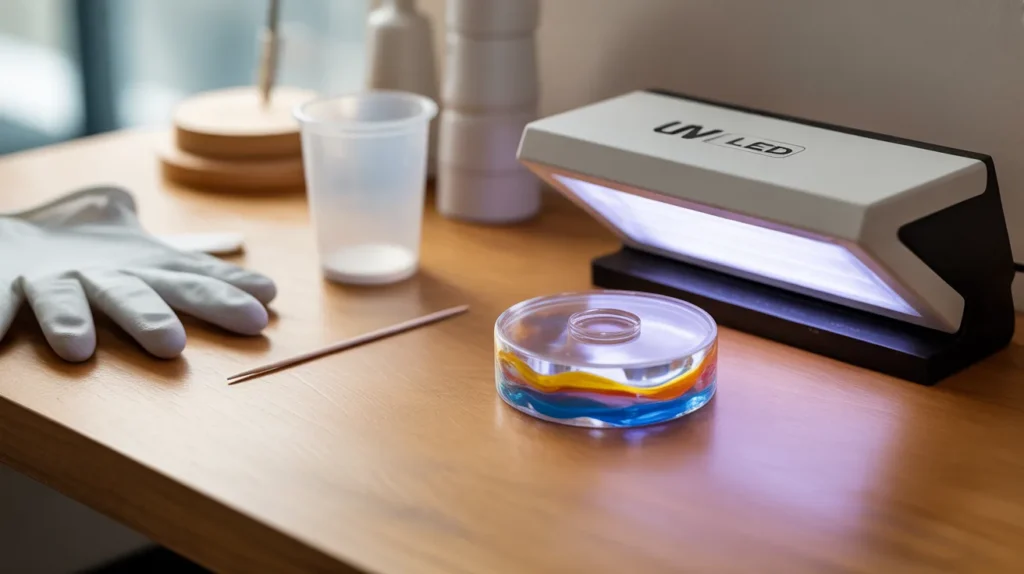
Introduction
If you want to learn how to use UV lamp for resin, using the correct UV lamp and curing technique is essential for achieving clear, hard, and professional-looking resin projects. UV resin hardens when exposed to ultraviolet (UV) light, making the correct curing method important for strong and smooth results. In this guide, you’ll learn how to use UV lamp for resin step by step, understand the basics of the UV resin curing process, choose the right UV light, avoid common curing mistakes, and create durable resin crafts with a professional finish.
Table of Contents
Types of UV Lamps for Resin
Choosing the right UV lamp is important for getting smooth and fully cured resin pieces. Not all lamps work the same way, and understanding the differences will help you pick the best option for your projects.
UV vs LED Lamps
There are two main types of lamps used for curing resin: UV lamps and UV LED lamps.
- UV Lamps (Traditional)
These use fluorescent bulbs to produce ultraviolet light. They are usually more affordable but take longer to cure resin. Bulbs may also need replacement over time. - UV LED Lamps
These are more modern and efficient. They cure resin much faster and last longer than traditional UV bulbs. Most beginners prefer LED lamps because they are quick, energy-efficient, and easy to use
Nail Lamps vs Resin-Specific Lamps
Many beginners wonder if they can use a nail lamp for resin projects.
- Nail Lamps
Originally designed for gel nails, these lamps can still cure UV resin. They are widely available and budget-friendly. However, they may have limited space and slightly uneven light distribution. - Resin-Specific Lamps
These are designed specifically for resin crafting. They often provide better light coverage, making curing more even. They are ideal if you plan to work on larger or more detailed pieces.
Wattage and Size Options
UV lamps come in different wattages and sizes, which affect performance:
- Low Wattage (6W–24W)
Suitable for small projects but may require longer curing time. - Medium Wattage (36W–72W)
A good balance for beginners and regular use. - High Wattage (80W–120W+)
Best for faster curing and thicker layers.
Size also matters. Smaller lamps are portable and good for tiny crafts, while larger lamps can handle bigger molds and multiple pieces at once.
Which Type Should You Choose?
If you are just starting out, a UV LED nail lamp with medium wattage is usually the best choice. It is affordable, easy to find, and works well for most small resin projects. For more advanced work, a resin-specific lamp can provide better results and more consistent curing. Understanding these types will help you choose the right tool and improve the quality of your finished resin pieces.
Wattage and Power: How It Affects Curing
Wattage plays a key role in how quickly and effectively resin cures under a UV lamp. In simple terms, wattage refers to the power output of the lamp. The higher the wattage, the stronger the light intensity, which usually means faster curing.
How Wattage Impacts Curing Time
Lamps with higher wattage can cure resin more quickly because they produce more UV light. For example:
- A low-watt lamp (6W–24W) may take longer and might not fully cure thicker layers.
- A medium-watt lamp (36W–72W) offers balanced performance and is suitable for most beginner projects.
- A high-watt lamp (80W–120W or more) can cure resin much faster and is ideal for thicker layers or multiple pieces.
- However, faster is not always better. If the light is too strong, it can cause overheating, bubbles, or uneven surfaces.
Finding the Right Balance
Using the correct wattage helps you avoid common issues like sticky or under-cured resin. A medium-watt lamp is often the safest choice because it provides enough power without risking damage to your project. It’s also important to adjust curing time based on the lamp’s power. Lower wattage requires longer exposure, while higher wattage needs shorter but controlled curing intervals.
Thickness Matters
Wattage alone does not determine the final result. The thickness of the resin layer also affects curing:
- Thin layers cure quickly and evenly under most lamps
- Thick layers need more time and sometimes multiple curing rounds
Working in thin layers is always recommended, especially when using a lower-watt lamp.
Tips for Better Results
- Match curing time with your lamp’s wattage
- Avoid pouring thick layers at once
- Test your lamp on small pieces before starting a project
- Keep the lamp at the correct distance for even light exposure
- Understanding how wattage affects curing will help you get stronger, clearer, and more professional-looking resin pieces every time.
Step-by-Step Guide: How to Use UV Lamp for Resin
Using a UV lamp correctly is essential for getting a smooth, hard, and clear finish. Follow these simple steps to achieve the best results, even if you are a beginner.
Step 1: Prepare Your Workspace
Start by setting up a clean, well-ventilated area. Place your lamp on a flat surface and keep all your tools nearby. Make sure your molds, resin, and accessories are ready before you begin.
Step 2: Pour the Resin in Thin Layers
Carefully pour a small amount of resin into your mold. It’s important to work in thin layers rather than one thick pour. Thin layers cure more evenly and reduce the risk of bubbles or sticky spots.
Step 3: Remove Bubbles
If you see bubbles, gently pop them using a toothpick or by lightly blowing over the surface. You can also let the resin sit for a few seconds before curing to allow bubbles to rise.
Step 4: Place Under the UV Lamp
Position your piece directly under the lamp. Make sure the light covers the entire surface evenly. If your lamp has a timer, select the appropriate setting based on the resin brand and layer thickness.
Step 5: Cure for the Recommended Time
Turn on the lamp and let the resin cure. Most thin layers take 30 to 120 seconds, depending on the lamp’s power. Avoid moving the piece during this process to ensure a smooth finish.
Step 6: Check the Surface
After curing, gently touch the surface. If it feels hard and non-sticky, it is properly cured. If it still feels soft or tacky, place it back under the lamp for additional time.
Step 7: Repeat for Additional Layers
If your design requires more depth or decoration, repeat the process layer by layer. Cure each layer before adding the next one to maintain clarity and strength.
Step 8: Final Cure and Finishing
Once your piece is complete, give it a final cure to ensure everything is fully hardened. After that, remove it from the mold and clean or polish if needed.
Quick Tips for Better Results
- Keep layers thin for even curing
- Do not rush the process
- Use the correct curing time for your lamp
- Rotate the piece if needed for full coverage
Following these steps will help you create clean, durable, and professional-looking resin pieces with consistent results.
Curing Time and Layer Thickness
Curing time and layer thickness are closely connected when working with UV resin. Getting this balance right is essential for achieving a hard, clear, and smooth finish without defects.
Why Thin Layers Work Better
UV light cannot penetrate very deep into resin. That’s why thin layers cure faster and more evenly. If the layer is too thick, the top may harden while the bottom remains soft or sticky. For best results, apply resin in layers of about 1–3 mm. This allows the light to reach all areas and ensures proper curing throughout.
Average Curing Time
Curing time depends on the lamp power, resin brand, and layer thickness. In general:
- Thin layers (1–2 mm): 30 to 60 seconds
- Medium layers (2–3 mm): 60 to 90 seconds
- Slightly thicker layers: up to 120 seconds or more
If the resin is still soft after curing, it simply needs more time under the lamp.
Problems with Thick Layers
Applying thick layers can lead to several issues:
- Sticky or uncured bottom layer
- Trapped bubbles inside the resin
- Uneven or cloudy finish
- Overheating or slight warping
These problems are common among beginners and can easily be avoided by working in thin layers.
Layer-by-Layer Method
Instead of pouring a large amount at once, build your piece gradually:
- Pour a thin layer
- Cure it completely
- Add the next layer
- Repeat until finished
This method not only improves curing but also gives better control over design and clarity.
Tips for Best Results
- Always keep layers thin and even
- Adjust curing time based on thickness
- Be patient—rushing leads to poor results
- Test your timing with small pieces first
By understanding how curing time and thickness work together, you can avoid common mistakes and create strong, professional-quality resin projects every time.
Common Problems and How to Fix Them
Even with the right tools, small issues can happen during resin curing. The good news is that most problems are easy to fix once you understand the cause.
Sticky or Tacky Surface
Problem: The surface feels soft or sticky after curing.
Causes:
- Not enough curing time
- Low lamp power
- Layer too thick
Solution:
Place the piece back under the lamp for additional time. If the issue continues, apply a thin top layer and cure again. Always work in thinner layers to avoid this problem.
Resin Not Fully Hardening
Problem: The resin stays soft or flexible instead of becoming solid.
Causes:
- Weak or old lamp
- Incorrect distance from the light
- Poor-quality resin
Solution:
Check your lamp’s performance and move the piece closer to the light source. You may also need to switch to a higher wattage lamp or a better-quality resin.
Bubbles in the Resin
Problem: Small air bubbles are trapped inside the resin.
Causes:
- Fast pouring
- Thick layers
- Mixing or handling too quickly
Solution:
Pour slowly and in thin layers. Use a toothpick to remove bubbles before curing. Let the resin sit briefly so bubbles can rise to the surface.
Uneven or Partial Curing
Problem: Some parts are hard while others remain soft.
Causes:
- Uneven light exposure
- Large or complex shapes
- Lamp not covering the entire piece
Solution:
Rotate your piece during curing or reposition it so all sides receive equal light. For larger items, cure in sections.
Overheating or Warping
Problem: The resin becomes too hot, causing slight bending or surface damage.
Causes:
- Very high lamp power
- Long continuous curing time
- Thick layers
Solution:
Cure in shorter intervals instead of one long session. Allow the piece to cool between rounds, especially when using a high-power lamp.
Cloudy or Dull Finish
Problem: The resin looks unclear instead of glossy.
Causes:
- Incomplete curing
- Dust or dirt on the surface
- Poor-quality mold
Solution:
Ensure full curing and keep your workspace clean. You can also apply a thin clear top coat and cure again to restore shine.
Quick Tips to Avoid Problems
- Always work in thin layers
- Use the correct curing time
- Keep your lamp clean and properly positioned
- Test new materials before starting a big project
Understanding these common issues will help you fix mistakes quickly and improve the overall quality of your resin creations.
Safety Tips When Using UV Lamps
Working with UV lamps is generally safe, but it’s important to follow basic precautions to protect your skin, eyes, and overall health. Simple safety habits can make a big difference, especially if you work on resin projects regularly.
Protect Your Eyes
UV light can be harmful if you look at it directly for long periods.
- Avoid staring directly at the light source
- Use protective glasses if you work frequently
- Turn off the lamp when not in use
Take Care of Your Skin
Long exposure to UV light may affect your skin over time.
- Keep your hands under the lamp only when necessary
- Use gloves or apply UV-protective cream if needed
- Avoid repeated exposure during long sessions
Work in a Well-Ventilated Area
Resin can release mild fumes during use.
- Always work in a space with good airflow
- Open windows or use a small fan
- Avoid working in closed, tight spaces
Avoid Direct Contact with Resin
Uncured resin can irritate the skin.
- Wear disposable gloves while handling resin
- Clean spills immediately
- Wash your hands after finishing your work
Use the Lamp Correctly
Improper use can lead to overheating or uneven curing.
- Follow the recommended curing time
- Do not overload the lamp with too many pieces
- Allow the lamp to cool down between sessions if needed
Keep Your Workspace Clean
A clean workspace reduces risks and improves results.
- Keep tools organized
- Avoid dust and dirt around your project
- Store resin and equipment safely after use
Quick Safety Reminders
- Do not touch uncured resin with bare hands
- Limit direct exposure to UV light
- Keep materials away from children and pets
- Always follow instructions provided with your tools
By following these safety tips, you can enjoy resin crafting while protecting yourself and creating in a safe, comfortable environment.
Nail Lamp vs Resin Lamp (Detailed Comparison)
When choosing a lamp for curing resin, many beginners compare nail lamps with resin-specific lamps. While both use UV light, they are designed for different purposes, which affects their performance and results.
Purpose and Design
- Nail Lamps
These are made for curing gel nail polish, which is applied in very thin layers. Their design focuses on small areas like fingernails. - Resin Lamps
These are built specifically for resin projects such as jewelry, molds, and crafts. They are designed to handle larger surfaces and thicker materials.
👉 Because of this difference, nail lamps may struggle with larger or deeper resin pieces.
Light Intensity and Wattage
- Nail Lamps: Usually lower wattage (around 6W–54W)
- Resin Lamps: Often higher wattage (48W–120W or more)
Higher power means stronger UV output, which helps cure resin more deeply and evenly. Nail lamps may not provide enough intensity for thicker layers, leading to incomplete curing.
Wavelength Compatibility
Resin cures when exposed to specific UV wavelengths.
- Nail lamps typically emit light in a narrow range designed for nail gels
- Resin lamps are optimized for wavelengths that match common UV resins (usually around 365–405 nm)
If the wavelength does not match the resin, curing may be weak or uneven.
Coverage and Size
- Nail Lamps: Small curing area, suitable for tiny items
- Resin Lamps: Larger space for molds, jewelry, and multiple pieces
Limited coverage in nail lamps can cause uneven curing, especially on bigger projects.
Curing Performance
- Nail lamps work best for very thin layers or small details
- Resin lamps provide faster, deeper, and more consistent curing
Using the wrong lamp can lead to sticky surfaces, weak structure, or uncured areas inside the piece.
When You Can Use a Nail Lamp
A nail lamp can still be useful in some cases:
- Small jewelry pieces
- Thin coatings or top layers
- Quick fixes or surface curing
However, it is not ideal for thick layers or large molds.
Pros and Cons
Nail Lamp – Pros
- Affordable and easy to find
- Compact and beginner-friendly
- Good for small projects
Nail Lamp – Cons
- Limited power and coverage
- May cause uneven curing
- Not suitable for large or thick pieces
Resin Lamp – Pros
- Stronger and more reliable curing
- Better coverage for bigger projects
- Designed for consistent results
Resin Lamp – Cons
- Slightly more expensive
- Larger size may take more space
Which One Should You Choose?
If you are just starting and working on small crafts, a nail lamp can be a budget-friendly option. But for better quality, faster curing, and fewer problems, a resin-specific lamp is the more reliable choice. Understanding these differences will help you choose the right tool and improve the overall quality of your resin projects.
Pro Tips for Perfect Resin Curing
Getting a flawless finish in resin crafting requires more than just pouring and curing. A few professional techniques can help you achieve smooth, clear, and durable results every time.
Work in Thin Layers
Applying resin in thin layers allows the UV light to penetrate evenly. Thick pours can lead to sticky spots or incomplete curing. Build your piece gradually, layer by layer, for the best results.
Keep the Lamp at the Right Distance
Positioning your lamp too close or too far can affect curing. Too close may overheat the resin, while too far can leave areas undercured. Maintain a consistent distance as recommended by the lamp manufacturer.
Rotate Pieces During Curing
For complex shapes or molds with multiple angles, rotate the piece under the light. This ensures even exposure on all surfaces and prevents uneven hardness or cloudiness.
Clean Your Lamp Regularly
Dust and resin residue on the lamp cover can block UV light, reducing efficiency. Wipe the lamp surface with a soft, dry cloth before each session to maintain consistent curing power.
Avoid Overheating
UV resin can get warm during curing, especially under high-power lamps. Cure in short intervals if necessary, allowing the piece to cool between sessions to prevent warping or bubbles.
Use Reflective Surfaces
Placing your piece on a reflective surface, like aluminum foil, can improve light coverage. This ensures all angles receive adequate exposure, resulting in a more even cure.
Test Before Large Projects
Before committing to a big project, test the resin and lamp setup on a small piece. This helps you determine the correct curing time and identify any potential issues beforehand.
Store Materials Properly
Keep your resin and lamp in a cool, dry place. Avoid prolonged exposure to sunlight or heat, which can affect resin quality and curing performance.
Quick Recap
- Thin layers cure better than thick ones
- Maintain proper lamp distance and rotate pieces
- Keep your equipment clean and organized
- Test materials before starting large projects
Following these pro tips will help you achieve consistently strong, clear, and professional-looking resin pieces every time.
FAQs
Can I use a nail lamp to cure resin?
Yes, a nail lamp can cure small resin projects and thin layers. However, for larger molds or thicker pieces, a resin-specific lamp provides more consistent results and faster curing.
How long does UV resin take to cure?
Curing time depends on layer thickness and lamp power. Thin layers typically cure in 30–60 seconds, while slightly thicker layers may take 90–120 seconds. Always follow the resin manufacturer’s recommended timing for the best finish.
Why is my resin sticky after curing?
A sticky or tacky surface often occurs when layers are too thick, the lamp is too weak, or the curing time is insufficient. Applying thinner layers and curing fully can fix this issue.
Can thick layers of resin be cured at once?
Thick layers may not cure evenly, leaving the bottom soft while the top hardens. It’s better to pour resin in thin layers and cure each layer individually to prevent bubbles or uneven surfaces.
Is UV resin safe to use?
UV resin is generally safe if handled properly. Always wear gloves, avoid direct skin contact, work in a ventilated area, and protect your eyes from UV light. Following these precautions ensures safe crafting.
How can I prevent bubbles in resin?
To reduce bubbles, pour resin slowly, use thin layers, and let it sit for a few seconds before curing. You can also pop bubbles with a toothpick or gently blow on the surface.
What’s the difference between UV and LED resin lamps?
UV lamps use fluorescent bulbs and may take longer to cure resin, while LED lamps are more energy-efficient and cure faster. LED lamps are generally preferred for small crafts and quick curing times.
How do I know when resin is fully cured?
A properly cured piece should feel hard and smooth without any sticky or soft spots. If the surface is still tacky, additional time under the lamp is needed.
Can I reuse resin molds for multiple layers?
Yes, reusable molds work best when cured layer by layer. Clean the mold between uses to avoid dust or residue, which can affect the clarity and finish of your resin pieces.
What are some tips for better resin curing?
Work in thin layers for even curing
Rotate pieces under the lamp to cover all angles
Keep lamps clean for maximum efficiency
Test new resin and lamp setups on small pieces first
Conclusion
Mastering how to use UV lamp for resin is essential for anyone looking to create high-quality, durable, and visually appealing resin crafts. By understanding the different types of lamps, the impact of wattage, proper layer thickness, and curing time, you can avoid common problems like sticky surfaces, bubbles, or uneven curing.
Safety is also a key factor protecting your eyes, skin, and working in a ventilated area ensures a safe and enjoyable crafting experience. Whether you choose a nail lamp for small projects or a resin-specific lamp for larger pieces, following the correct techniques will make your creations stronger and more professional-looking.
With practice and attention to detail, using a UV lamp can turn resin crafting into a smooth, efficient, and highly satisfying process. By applying the tips and steps outlined in this guide, you can confidently tackle any project and achieve perfect results every time.